IEEE International Conference on Human-Robot Interaction
Gazing at Failure: Investigating Human Gaze in Response to Robot Failure in Collaborative Tasks
Understanding Human Reactions to Robot Failures Through Gaze Dynamics
Abstract
Robots are prone to errors, impacting their credibility in human-robot collaboration. This study analyses human gaze dynamics as signals for robot failures, categorized as executional and decisional. A study with 27 participants solving tangram puzzles revealed that the type and timing of failures significantly affect gaze behaviour and perception. Executional failures led to increased gaze shifts toward the robot, while decisional failures resulted in less variability in gaze transitions, especially when occurring at task end. Gaze can thus reliably indicate failures and suggest recovery actions.
Project Demo
Overview
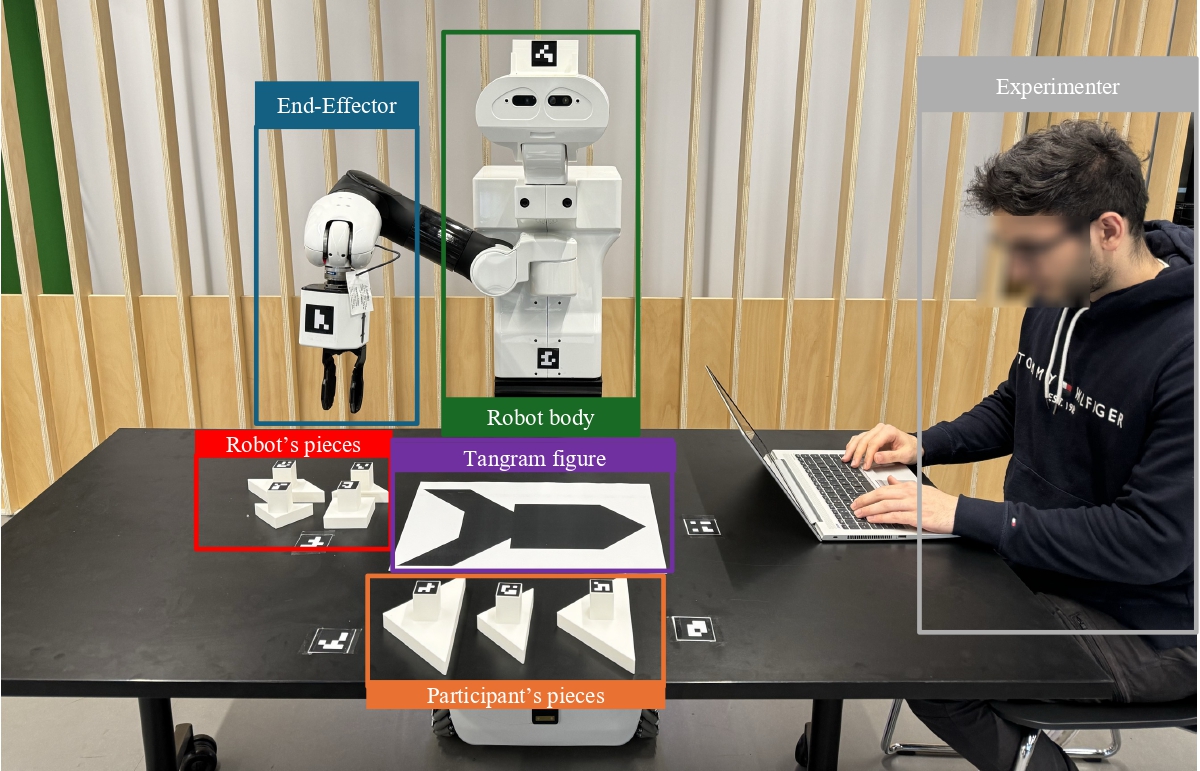
The research investigates the relationship between human gaze behaviours and robot failures. By conducting a study with robot-assisted tangram puzzles, the team explored how different failure types affect human perception and gaze dynamics, presenting gaze as a potential indicator for robot error detection and recovery.
Key Contributions
- Identified gaze patterns as indicators of robot failures.
- Demonstrated impact of failure types on human perception and gaze.
- Highlighted timing effects of failures on gaze distribution.
- Showed acknowledgment of failures influences perception.
Method and System
Participants worked with robots on tangram puzzles, experiencing both executional and decisional failures at different task stages, with varied acknowledgment from the robot.
Results Overview
- Executional failures caused more gaze shifts toward robots. - Decisional failures resulted in less variability in gaze transitions. - The timing of failures affected gaze distribution. - Gaze reliably indicates different types of robot failures.
Discussion
Limitations
The study involved a limited number of participants and types of failures, restricting the generalizability of the findings.
Future Work
Future research could explore more diverse failure types and investigate other non-verbal cues that might indicate robotic failures.
Figure Highlights
Citation
@inproceedings{hri2025-robotfailure,
  title={Gazing at Failure: Investigating Human Gaze in Response to Robot Failure in Collaborative Tasks},
  author={Ramtin Tabatabaei and Vassilis Kostakos and Wafa Johal},
  booktitle={IEEE International Conference on Human-Robot Interaction},
  pages={},
  year={2025},
  organization={IEEE}
}